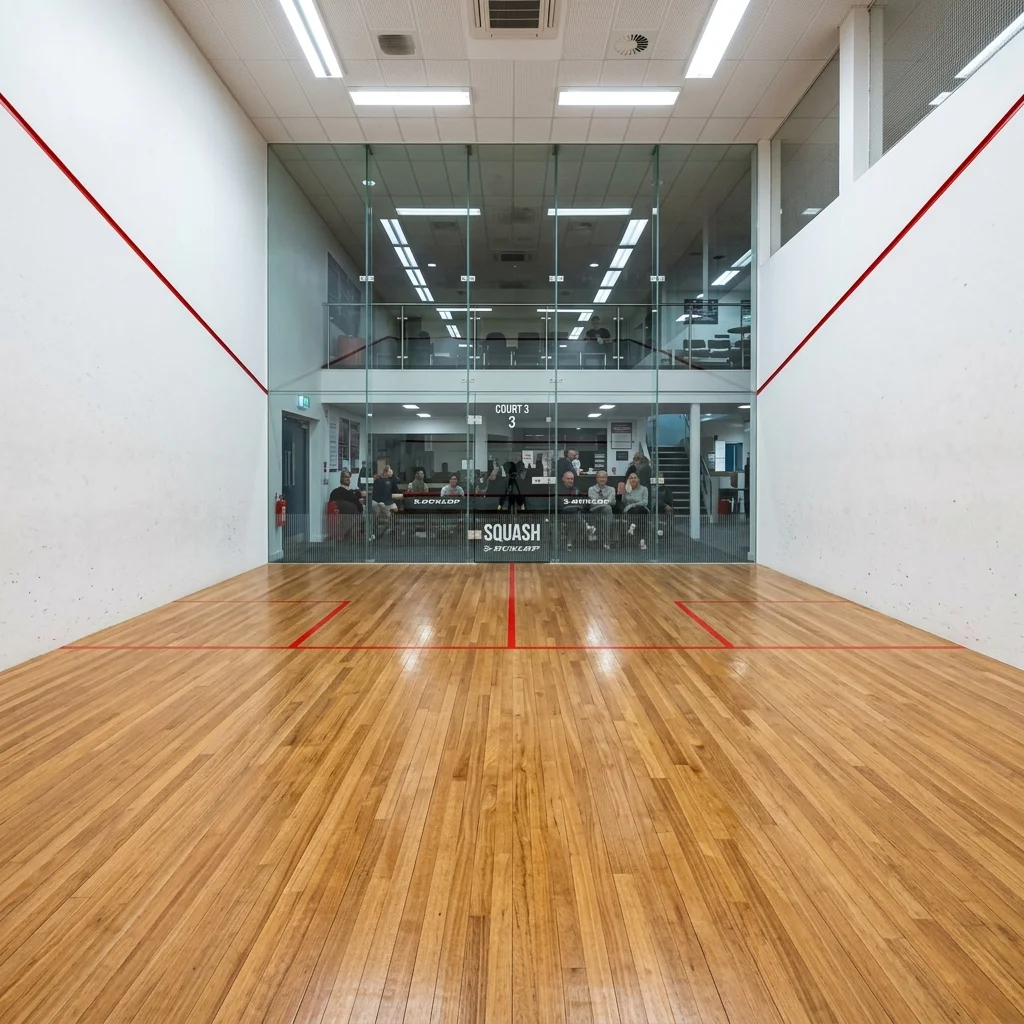
Precision sprung wooden squash courts constructed with kiln-dried Canadian Maple or Teakwood over an EPDM rubber shock pad substructure. The same timber sourcing and installation expertise UWIN Floortech applies to BWF-standard badminton courts - adapted to WSF squash court dimensions and requirements.
UWIN Floortech constructs squash court floors using the same precision timber sourcing and sprung-floor construction methodology as our BWF-standard badminton courts - kiln-dried Canadian Maple or Teakwood, tongue-and-groove precision milling, and EPDM rubber shock pad substructure - adapted to World Squash Federation (WSF) squash court dimensions and requirements.
A squash court floor must withstand a specific set of mechanical demands that differ from a badminton court. The ball is denser, impacts the floor at acute angles, and players execute rapid direction changes on a confined surface. The sprung wooden floor construction that delivers these properties - shock absorption, consistent rebound, and joint protection - is the same fundamental system used in international squash court construction globally.
Important Certification Note: UWIN Floortech's documented BWF (Badminton World Federation) surface expertise applies specifically to badminton court construction. Squash courts are governed by the World Squash Federation (WSF), which has its own court specification and certification standards. Our timber sourcing, construction methodology, and installation expertise are directly applicable to squash court builds.


Canadian Maple is the international standard for competitive squash courts - uniform grain density, consistent hardness, and predictable ball response under all court conditions. Teakwood is the premium Indian alternative for institutional and club courts where natural moisture resistance and aesthetic quality are as important as performance consistency.
Canadian Maple (Sports-Grade, Kiln-Dried): The timber used in international professional squash courts. Maple's uniformly dense grain structure means the ball responds consistently regardless of where it contacts the floor - a property squash players at competitive level depend on. High tensile strength and hardness resist the impact loads of a squash ball travelling at speed. Kiln-drying to precise moisture content prevents post-installation warping - critical in Indian climates where ambient humidity varies significantly across seasons.
Teakwood (Premium Grade, Naturally Durable): Teak's naturally high oil content provides inherent moisture resistance - an advantage in coastal and high-humidity Indian locations where external humidity variation is a long-term concern for timber floors. The warm, rich aesthetic of teak makes it the choice for premium sports clubs and institutional facilities where the visual quality of the court is part of the facility's prestige.
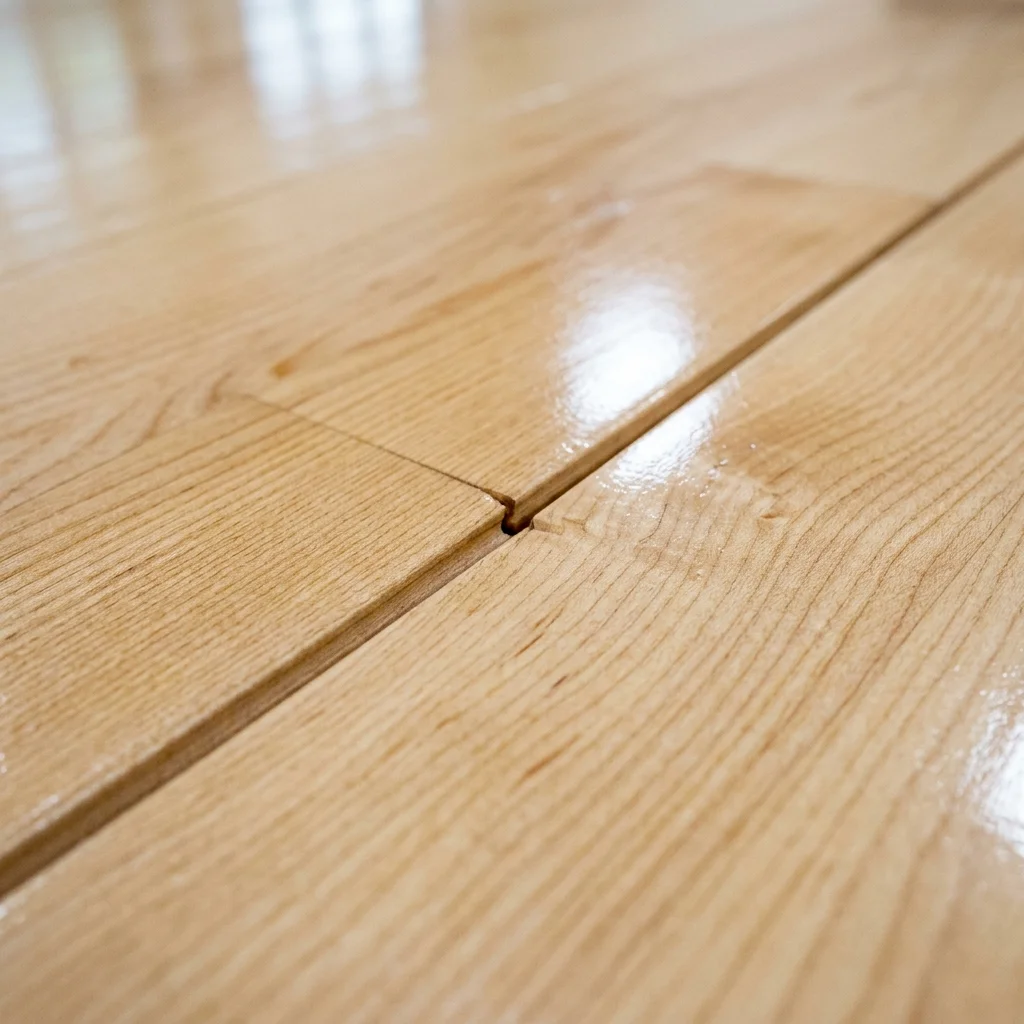
Both species are precision-milled to tongue-and-groove profiles before installation, ensuring tight board-to-board joints that eliminate gaps, resist moisture ingress, and maintain surface uniformity across the entire court dimension.
A professional squash court floor is not a flat timber surface laid on concrete. It is a multi-tiered sprung system where each layer serves a specific structural or performance function. The floor's shock absorption, rebound quality, and longevity depend on every layer being correctly specified and installed in sequence.
Minimum M20-grade structural concrete slab, steel-reinforced and fully cured. Moisture assessment is conducted before any subsequent layers begin. Ground-floor squash courts require a damp-proof membrane between the concrete and the EPDM shock pad to prevent rising dampness from affecting the timber above.
EPDM rubber pads placed across the concrete slab before the sleeper grid is laid. This layer performs two critical functions: shock absorption (protecting players' knees and ankles during the explosive direction changes squash requires) and acoustic decoupling (reducing impact noise transmission to rooms below the court).
Timber battens laid over EPDM pads in a specified grid pattern to create the structural framework that supports the finished floor. Anti-termite treatment of all sleeper timber is mandatory before laying begins - this is the single most important installation step for protecting a 15 to 25 year timber investment from biological damage.
Kiln-dried Canadian Maple or Teakwood boards, precision-milled to tongue-and-groove profile, laid in the court direction over the sleeper grid. Each board is blind-nailed through the tongue to the sleeper below - no visible fasteners on the playing surface. The result is a seamless, joint-tight surface with consistent rebound response across the full court dimension.
Machine-sanded to a glass-flat finish, then sealed with sports-grade court lacquer. Court lines are marked in WSF-standard dimensions and colours. The sealed surface provides the correct grip coefficient for squash footwear while protecting the timber against sweat, ball impact wear, and cleaning chemicals over the court's operational life.
Full court handover with written documentation of materials used, installation date, and recommended maintenance schedule. Refinishing recommendation: every 3 to 5 years depending on court usage intensity. A properly maintained sprung wooden squash court built by UWIN Floortech will outlast two generations of club membership.
The squash court sub-base assessment is the most critical step before any timber installation begins. A compromised concrete slab - moisture issues, structural cracks, insufficient grade - will telegraph through the wooden floor within 12 to 18 months regardless of timber quality or installation precision.
| Concrete Grade | Minimum M20 - steel-reinforced, fully cured. Sub-base must be assessed before installation begins. |
| Moisture Control | Ground-floor courts: damp-proof membrane mandatory between concrete and EPDM shock pad. Rising dampness is the primary cause of timber warping in squash courts. |
| Anti-Termite Treatment | Mandatory on all wooden sleeper framework before timber boards are laid. Protects the 15 to 25 year timber investment from biological damage. |
| Surface Flatness | Maximum 2mm deviation over any 3-metre span. The sprung floor system cannot compensate for significant sub-base undulations. |
| Room Height Clearance | WSF squash court specification requires a minimum internal height of 5.64m. |
UWIN Floortech's squash court construction capability serves sports clubs and academies building dedicated squash facilities, premium residential developments with clubhouse squash courts, and institutional sports complexes requiring professionally constructed indoor court infrastructure.
Squash club owners and sports academy directors building dedicated courts for member use and competitive training. Budget Rs 3L–30L per court depending on timber species, court count, and wall construction scope. UWIN Floortech handles the floor construction - from sub-base assessment to final line marking and court handover.
Residential developers and RWA committees specifying a squash court as a premium clubhouse amenity. A professionally constructed wooden squash court - Canadian Maple or Teakwood, sprung substructure - significantly differentiates a premium residential project's sports and recreation offering. Budget context within the Rs 10L–1Cr+ multi-sport township development range.
Government sports authorities, university sports departments, and institutional sports complex managers building squash courts as part of multi-sport indoor facilities. UWIN Floortech provides full material documentation for tender compliance and handles installation across Pan India locations. GST-compliant invoicing and MSME documentation available for government procurement.
UWIN Floortech sources Canadian Maple and Teakwood directly from certified timber producers - removing the trading intermediary that typically adds 25 to 40% to market-sourced timber prices. The cost you receive from UWIN includes certified timber at production pricing, an EPDM shock pad substructure, precision installation, and final court line marking - one point of contact, one contract.
Precise answers to the most common questions received regarding squash court flooring construction in India. The certification distinction between squash (WSF) and badminton (BWF) is addressed directly below.
No. Squash courts and badminton courts share the use of sprung wooden flooring as the international standard, but the governing bodies and court specifications differ entirely. Squash courts are governed by the World Squash Federation (WSF), which defines its own court dimensions, wall construction, and playing surface requirements. Badminton courts are governed by the Badminton World Federation (BWF). UWIN Floortech's wooden flooring construction expertise - kiln-dried Canadian Maple or Teakwood, tongue-and-groove precision milling, sprung sub-floor with EPDM shock pad - is directly applicable to squash court construction, but our BWF-specific documentation applies to badminton surfaces, not squash courts.
Canadian Maple is the most widely used timber for professional squash courts internationally. Its uniform grain structure, consistent hardness, and high tensile strength deliver the predictable ball bounce response squash players rely on at high-level play. Teakwood is a viable alternative for Indian institutional facilities where the natural moisture resistance of teak and its aesthetic richness are priorities.
A squash court wooden floor requires a structurally sound concrete slab (minimum M20 grade) as the base, followed by an EPDM rubber shock pad layer, a wooden sleeper grid framework, and precision-milled tongue-and-groove timber boards. Anti-termite treatment of the sleeper framework is mandatory before timber laying begins. A damp-proof membrane is required on ground-floor courts to prevent timber warping from rising dampness.
A properly constructed and maintained sprung wooden squash court floor, built with kiln-dried Canadian Maple or Teakwood over an EPDM shock pad substructure, lasts 15 to 25 years. This lifespan assumes refinishing (sanding and resealing) every 3 to 5 years depending on court usage intensity, and protection from water ingress through the sub-base or wall interfaces. WhatsApp us at +91 98216 48112 to discuss your squash court specification.
Share your room dimensions and timber preference - Canadian Maple or Teakwood - and we'll send a preliminary construction specification and cost estimate within 4 hours. No obligation. No middlemen.