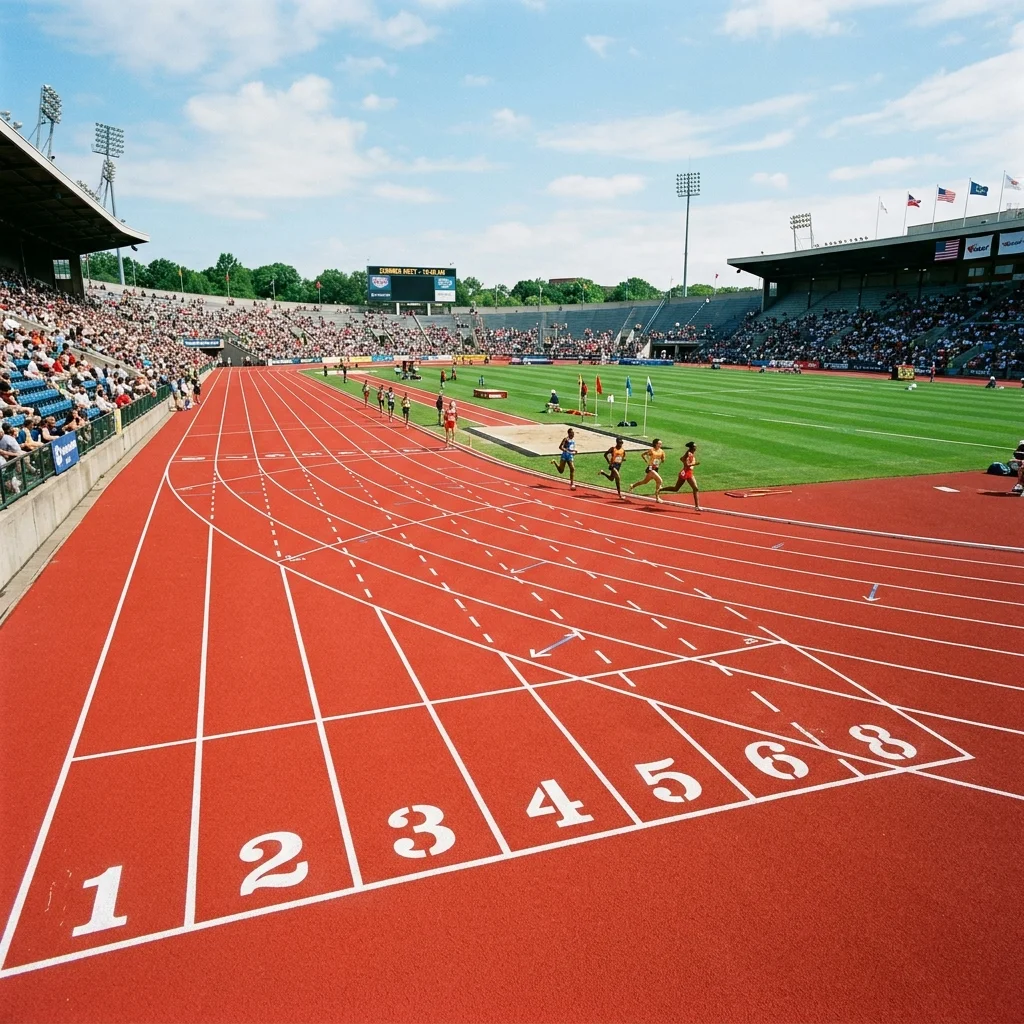
EPDM rubberised running and sprint track systems built to IAAF-specification dimensions. Installed manufacturer-direct across India for schools, universities, and government stadiums.
UWIN Floortech supplies and installs EPDM Rubberised Tracks and Play Area Surfaces for athletic running tracks across India. The system uses EPDM (Ethylene Propylene Diene Monomer) granules bound with a polyurethane MDI moisture-cure binder, installed in two configurations depending on budget and performance requirement.
EPDM is the material of choice for professional athletic tracks globally, and for sound technical reasons. Unlike low-grade recycled rubber or painted concrete alternatives, EPDM is a virgin synthetic rubber compound with inherent UV resistance, meaning the surface retains its colour and structural integrity across Indian outdoor conditions - monsoon humidity, summer heat, and direct UV exposure - for 8 to 10 years without significant degradation.
The polyurethane MDI (methylene diphenyl diisocyanate) moisture-cure binder used in UWIN EPDM systems is a single-component system that cures on ambient moisture - making it the correct binder formulation for Pan India installation across varied humidity conditions. It maintains granule adhesion and surface integrity at temperatures well beyond Indian summer extremes.
Hard concrete tracks and low-grade surfaces cause knee injuries, joint strain, and shin splint conditions in student athletes. For school and university sports administrators, surface selection is not just a procurement decision - it is a student health and institutional liability decision. EPDM's shock-absorbing properties are the primary reason sports medicine practitioners recommend rubberised surfaces for running and sprint training at all age levels.

UWIN Floortech installs three EPDM system configurations for athletic tracks. The correct system depends on budget, track usage intensity, and whether the application is a competition-standard oval or a school sprint straight.
100% EPDM granule system at 13mm to 25mm thickness. The primary recommendation for dedicated athletic tracks, high-wear sprint zones, and competition-standard facilities where maximum energy return and durability are the specification requirement. No SBR base - the full depth is EPDM granule throughout.
View EPDM Product Details →10mm SBR rubber base layer + 3mm EPDM colour top wear layer = 13mm total. This layered construction matches the dimensional specification used for IAAF-compliant track surfaces. The SBR base provides cushioning; the EPDM top provides UV-stable colour, grip, and durability. Recommended for schools, universities, and institutional tracks where IAAF-specification dimensions are required at a more accessible cost than a full-pour system.
View EPDM Product Details →A thin EPDM spray applied over an existing structurally sound surface - jogging paths, fitness park circuits, and pathway resurfacing. This is not a track-construction system and is not recommended as the primary surface for athletic sprint or distance training. Suitable for lower-intensity recreational use and pathway renewal only.
Discuss Your Application →The specifications below apply to UWIN's EPDM rubberised track systems. The critical distinction between SBR and EPDM layers must be understood before specifying any track system - they serve entirely different functions in the construction stack.
| Top Layer Material | EPDM granules - 100% virgin compound. UV-resistant, colour-stable, the durable playing surface. |
| Base Layer Material | SBR granules (recycled rubber) - cushion sub-base only. Used in sandwich system. Never used as the top wear surface. |
| Binder | Polyurethane MDI (methylene diphenyl diisocyanate) - moisture-cure, single-component. Maintains granule adhesion across temperature and humidity extremes. |
| Track Thickness - Sandwich | 13mm total: 10mm SBR base + 3mm EPDM top wear layer. IAAF-specification dimensional standard. |
| Track Thickness - Full-Pour | 13mm to 25mm, 100% EPDM granule throughout. Thickness selected based on traffic intensity and competition standard. |
| UV Stability | Colour-stable for 8 to 10 years in Indian outdoor conditions - verified across monsoon, UV exposure, and heat extremes. |
| Colour Options | Red, green, blue, black - standard athletic track colours available. Multi-colour lane demarcation available. |
| Applicable Standards | Built to IAAF-specification dimensions for sandwich system thickness. |
EPDM rubberised tracks must be laid over a structurally sound, properly prepared concrete or asphalt base. The sub-base quality directly determines the finished track's longevity and surface uniformity. A track installed over a compromised base will develop hollows, joint failures, and drainage problems regardless of EPDM quality.
| Base Material | Concrete (minimum M20 grade) or dense-graded asphalt. Both must be structurally sound with no active cracking or subsidence. |
| Surface Preparation | Shot blasting or mechanical scarification to open the pore structure and improve EPDM binder adhesion. Contaminated surfaces (oil, paint) must be cleaned before any EPDM application begins. |
| Drainage Gradient | Sub-base must slope at a minimum 1% toward designated drainage outlets. EPDM is not self-draining - the base gradient manages water evacuation. |
| Surface Flatness | Maximum 3mm deviation over any 3-metre span. Undulations in the sub-base will telegraph through the EPDM layer and affect runner footing. |
| Crack Repair | Cosmetic cracks filled with polyurethane crack filler before EPDM application. Structural cracks require base repair - EPDM cannot bridge structural movement. |
UWIN Floortech's EPDM running track systems serve schools with outdoor athletics programmes, government contractors building public stadium and community track infrastructure, and residential developers specifying jogging tracks for township fitness facilities.
School trustees and university facilities managers choosing between painted concrete and EPDM. Hard concrete causes shin splints, knee impact, and slip injuries during PE and annual sports day events. EPDM's shock-absorbing surface is a student safety decision as much as a performance one. Budget Rs 5L–30L for school sprint straights and oval tracks.
CPWD, Smart Cities, and Khelo India programme contractors executing public stadium, community sports complex, and school athletics track specifications. UWIN supplies full material TDS sheets, production batch records, and GST-compliant invoicing for tender documentation. Budget Rs 25L–10Cr per project lot.
Project managers at residential developments specifying jogging tracks, fitness parks, and outdoor running circuits as township amenities. EPDM delivers the aesthetic of a professional surface with zero maintenance beyond routine sweeping and quarterly washing. Multi-sport township budgets range from Rs 10L to Rs 1Cr+ for full facility development.
UWIN Floortech builds athletic tracks to IAAF-specification dimensions for sandwich system thickness - specifically the 13mm total depth (10mm SBR + 3mm EPDM) that World Athletics defines for compliant track surfaces. This is a dimensional and construction specification claim, not a statement of full IAAF product certification.
World Athletics (formerly the International Association of Athletics Federations - IAAF) publishes the technical specification for synthetic running track surfaces. The specification defines, among other parameters, total track thickness, granule size ranges, binder type compatibility, and surface texture requirements.
For schools and institutional buyers who require an IAAF-specification track for state-level or inter-school competition, the sandwich system at 13mm (10mm SBR + 3mm EPDM) is the correct starting specification. For facilities targeting national-level competition hosting, the full-pour EPDM system at the specified thickness is the appropriate route, and certification confirmation should be obtained directly from the client before specifying the track for official competition use.

UWIN Floortech sources EPDM materials directly from certified producers and installs them with trained crews - removing the trading intermediary layer that adds 25 to 40% to market quotes from IndiaMART dealers. The price you receive from UWIN is the producer price plus installation, with no distributor margin between the two.
We conduct a sub-base assessment to verify concrete grade, surface flatness, existing crack conditions, and drainage gradient before any specification is issued. This step prevents the most common cause of EPDM track failure - installation over a structurally compromised base.
Based on site dimensions and usage requirements, we issue a written specification (system type, thickness, colour, lane marking) and a cost proposal with full material TDS documentation. Government contractors receive MSME registration details and GST-compliant documentation with every proposal.
Trained installation crew manages surface preparation, primer application, EPDM pour, and lane marking from start to handover. Curing time before track is open to athletes is confirmed in writing at project handover. No middlemen manage site operations - one point of contact, one crew, one accountable installation.
Specification-precise answers to the most common questions our technical team receives regarding EPDM athletic running track systems in India.
The IAAF-specification sandwich system for a running track is 13mm total thickness: 10mm SBR rubber base layer topped with 3mm EPDM colour wear layer. For higher-wear athletic tracks requiring greater energy return, a full-pour EPDM system at 13mm to 25mm is the correct specification. Never use the SBR base layer alone as a finished surface - it lacks the UV stability and colour retention properties of EPDM.
SBR (Styrene-Butadiene Rubber) is a recycled rubber compound used exclusively as the cushion base layer in sandwich track systems. EPDM (Ethylene Propylene Diene Monomer) is a virgin synthetic rubber used as the top wear layer - it is UV-resistant, colour-stable for 8 to 10 years in Indian outdoor conditions, and provides the durable running surface. The two materials are not interchangeable: EPDM is always the top layer, SBR is always the base.
A properly installed EPDM running track delivers colour stability and structural performance for 8 to 10 years under Indian outdoor conditions including monsoon, UV exposure, and summer heat. The polyurethane MDI moisture-cure binder maintains granule adhesion across temperature extremes. Annual inspection for joint separation and quarterly pressure washing are the two primary maintenance requirements to preserve lifespan.
Yes. We assess site dimensions and recommend the appropriate track configuration - full 400m competition format, a shorter sprint straight, or an oval sized to available space. For school budgets, the IAAF-specification sandwich system (10mm SBR + 3mm EPDM) delivers certified-dimension performance at a more accessible cost than full-pour EPDM. WhatsApp us at +91 98216 48112 with your site dimensions for a preliminary specification.
Share your site dimensions and intended use - competition track, school sprint straight, or township jogging circuit - and we'll send a detailed specification and cost estimate within 4 hours.