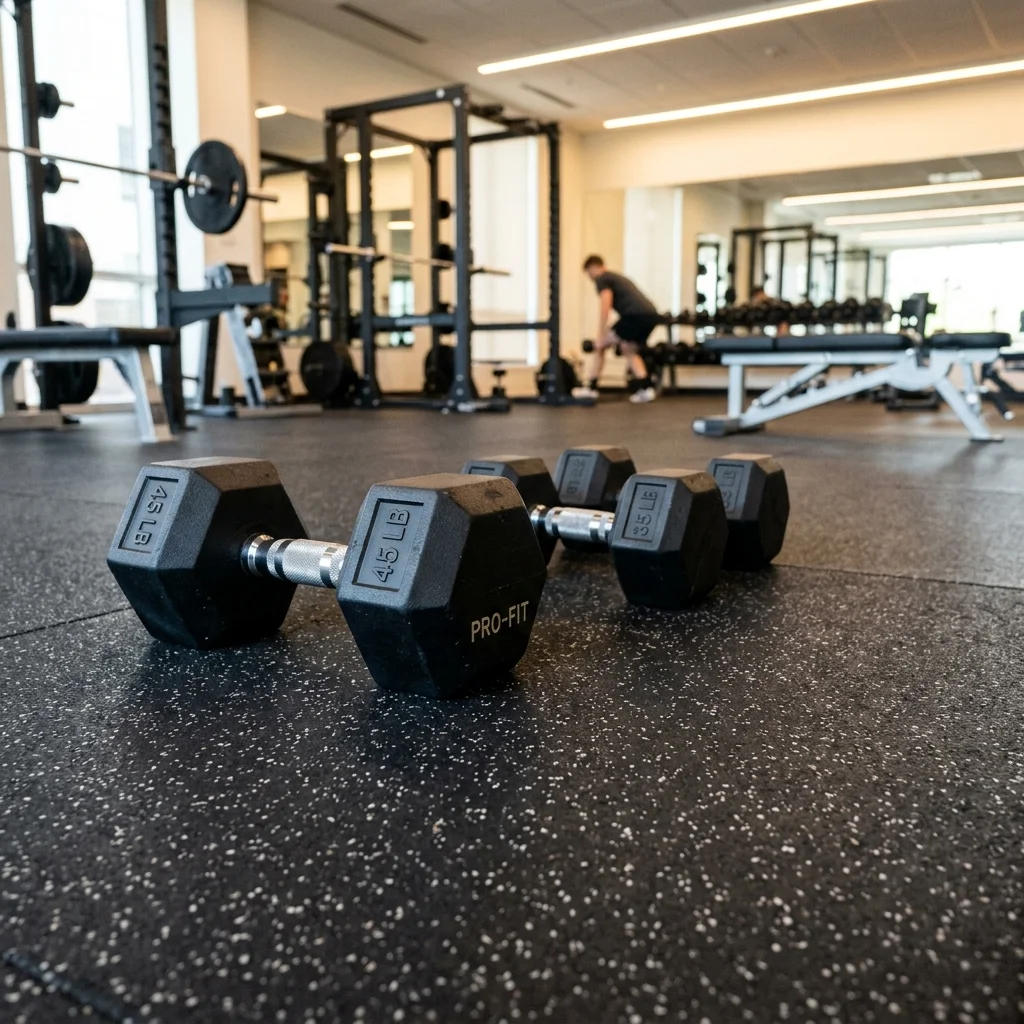
EPDM rubberised flooring for heavy weights and functional training, and PP interlocking tiles for multi-purpose gym halls. Manufacturer-direct supply and turnkey installation for schools, sports clubs, and fitness parks across India.
UWIN Floortech recommends two different systems for gymnasiums based on the facility's primary use: EPDM Rubberised Flooring for weight rooms and functional training zones requiring maximum shock absorption; and PP Interlocking Tiles for multi-purpose gym halls and PE facilities requiring a cleanable, modular court surface.
"Gymnasium" is a broad term that covers entirely different physical environments. A CrossFit box dropping heavy barbells has completely different flooring requirements than a school's multi-purpose PE hall where students play indoor sports and do aerobics. We do not force one product into both spaces.
If your facility focuses on free weights, functional training, or outdoor fitness park equipment, EPDM rubberised flooring is the correct choice. It provides a seamless, poured-in-place surface that protects athletes' joints from impact and protects the concrete sub-floor from dropped weights.
If your facility is a multi-purpose indoor hall used for school PE classes, indoor court sports, and general fitness, PP interlocking tiles are the correct choice. They provide a harder, modular surface that is highly hygienic, easy to clean, and can be line-marked for various sports activities.

EPDM rubberised flooring is a seamless, poured-in-place surface engineered for maximum shock absorption. It is the primary recommendation for free-weight areas, CrossFit boxes, functional training zones, and outdoor fitness parks. Unlike cheap rubber mats, EPDM is a virgin synthetic rubber that is highly durable, hygienic, and odourless indoors.
| Parameter | EPDM Specification |
|---|---|
| Material | EPDM (Ethylene Propylene Diene Monomer) virgin rubber granules. Highly durable, colour-retentive, and superior to recycled SBR. |
| Binder | Polyurethane MDI moisture-cure single-component binder. Ensures permanent granule adhesion under heavy loads. |
| Thickness | 13mm to 25mm full-pour system. Thicker pours recommended for dedicated olympic lifting and heavy drop zones to protect the concrete slab. |
| Performance | Maximum shock absorption. Protects athletes' knees and joints during plyometric movements; protects sub-floor from dropped weights. |
| Outdoor Suitability | Excellent. EPDM is UV-stable for 8–10 years in Indian outdoor conditions - the standard for open-air fitness parks and calisthenics zones. |
UV-stabilised PP interlocking tiles are the recommendation for school PE halls, aerobics studios, and multi-use indoor recreation rooms. The modular tile grid provides a clean, hard-wearing surface that supports both fitness classes and indoor court sports. The surface is highly hygienic and easy to clean compared to rubber mats.
| Parameter | PP Tile Specification |
|---|---|
| Material | High-impact Polypropylene Copolymer (PP). Rigid, durable, and highly resistant to scuffing from fitness equipment. |
| Tile Dimensions | 304.8mm × 304.8mm (12 inch × 12 inch). Modular click-lock installation with no adhesives required. |
| Thickness Options | 12.7mm standard / 15.8mm premium for high-traffic institutional use. |
| Hygiene & Maintenance | Non-porous plastic surface does not absorb sweat, odours, or moisture. Extremely easy to mop and maintain a hygienic gym environment. |
| Multi-Sport Capability | Can be permanently line-marked for indoor badminton, volleyball, or basketball alongside general fitness use. |

Unlike professional court sports (which govern surfaces via bodies like BWF or ITF), general gymnasium flooring is not governed by a specific sport-certification body. The primary standards for gym flooring are functional: shock absorption to prevent injury, slip resistance for safety under heavy loads, and surface hygiene.
Hard concrete floors and low-grade rubber mats are the leading cause of joint strain, knee injuries, and slip accidents in fitness environments. When an athlete performs plyometric jumps, or drops a kettlebell, the floor must absorb and dissipate that kinetic energy. UWIN's EPDM full-pour systems are engineered specifically to provide this critical shock absorption.
In multi-purpose halls, hygiene and cleanability are paramount. Cheap foam mats absorb sweat, breed bacteria, and degrade rapidly. Our PP interlocking tiles provide a non-porous, easily sanitized surface that maintains a clean, professional aesthetic for the lifetime of the facility, while still providing structural safety.
Both EPDM poured systems and PP modular tiles require a structurally sound, level concrete slab (minimum M20 grade). The quality of the finished gym floor depends entirely on the integrity of the concrete base beneath it.
| Concrete Grade | Minimum M20 - fully cured concrete. Must be structurally sound to withstand the heavy point-loads common in gym environments. |
| Moisture Control (EPDM) | For indoor EPDM installations, the concrete must be dry before the moisture-cure polyurethane binder is applied. Rising dampness can interfere with binder adhesion. |
| Surface Flatness | Maximum 3mm to 5mm deviation over a 3-metre span. A flat base is essential for both systems to ensure safe footing during weight training and equipment stability. |
| Drainage (Outdoor) | For outdoor fitness parks, the concrete base must slope at 1% toward drainage outlets. PP tiles drain vertically through the grid; EPDM relies on the base slope for water evacuation. |
UWIN Floortech's gymnasium flooring solutions serve schools building multi-purpose PE halls, sports clubs upgrading weight rooms and functional training zones, and residential developers specifying clubhouse gyms and outdoor fitness parks.
School principals and PE directors outfitting indoor sports halls and gymnasiums. PP interlocking tiles are the primary recommendation for school multi-purpose halls - offering a durable, cleanable surface that supports general PE, aerobics, and indoor court sports on a single budget-friendly installation.
Project managers specifying clubhouse gymnasiums and outdoor open-air fitness parks. EPDM rubberised flooring delivers a premium, seamless aesthetic for indoor weight rooms, and its 8-10 year UV stability makes it the only professional choice for outdoor calisthenics and fitness zones.
Commercial gym owners and CrossFit box operators. When heavy barbells are being dropped daily, a full-pour EPDM system is required to protect both the athletes and the building's structural concrete. UWIN provides manufacturer-direct pricing for large-scale commercial gym fit-outs.
UWIN Floortech operates on a manufacturer-direct model. We source EPDM granules, PU binders, and PP tiles directly from certified producers - eliminating the 25 to 40% margin added by IndiaMART trading middlemen. You receive production-level pricing and professional installation by a single accountable team.
Precise answers to the most common questions our technical team receives regarding indoor and outdoor gymnasium flooring in India.
Choose EPDM rubberised flooring (a full-pour seamless system) if your gym is focused on free weights, CrossFit, or functional training where joint protection and shock absorption from dropped weights are critical. Choose PP interlocking tiles if your facility is a multi-purpose gym hall, school PE facility, or aerobics studio requiring a harder, highly cleanable modular surface that can be line-marked for indoor sports.
SBR (Styrene-Butadiene Rubber) is a recycled rubber used as a cost-effective cushion base layer. EPDM (Ethylene Propylene Diene Monomer) is a virgin synthetic rubber used as the top wear layer. UWIN Floortech uses EPDM for the finished gym surface because it is highly durable, retains its colour, and does not produce the strong rubber odour associated with cheap SBR gym mats. For heavy-duty weight rooms, a full-pour EPDM system is recommended.
No sport-governing-body certification (such as IAAF or ITF) applies specifically to general gymnasium or fitness park flooring. The primary performance requirements for gym flooring are shock absorption (to protect athletes' joints and the concrete sub-floor), slip resistance (for safety under heavy loads), and hygiene (surface cleanability). Both our EPDM and PP tile systems are engineered to meet these functional safety requirements.
Both EPDM poured systems and PP modular tiles require a structurally sound, level concrete slab (minimum M20 grade). For indoor gyms, the concrete must be fully cured and dry before an EPDM moisture-cure binder can be applied. PP tiles can accommodate minor surface undulations better than poured systems, but a flat base is essential for both to ensure safe footing during weight training.
Send us your facility dimensions and primary usage - free weights vs multi-purpose hall. We'll recommend the correct surface system and provide a cost estimate within 4 hours.