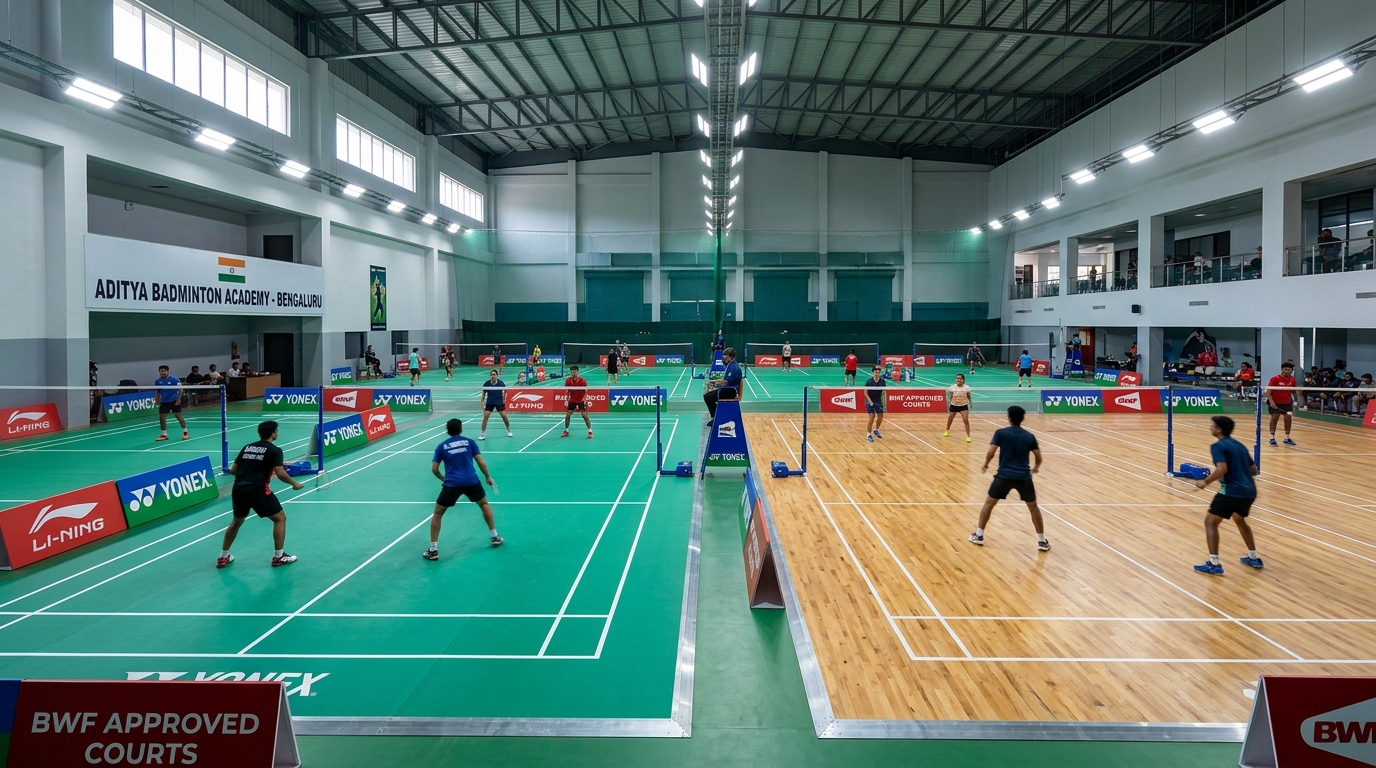
The Complete Guide to Badminton Court Flooring in India: PVC Vinyl vs Wooden
When educational institutions, professional academies, and sports clubs plan to develop indoor badminton facilities in India, the most critical foundational decision is the flooring specification. The surface directly dictates athlete safety, gameplay consistency, and the facility’s long-term operational costs. For indoor badminton, the decision invariably comes down to two primary systems: high-performance PVC vinyl sports flooring and premium sports-grade wooden flooring.
This comprehensive guide breaks down the technical specifications, performance metrics, and cost implications of both systems to help institutional buyers make exact, data-driven procurement decisions that meet BWF (Badminton World Federation) standards.
Table of Contents
Understanding Badminton Flooring Requirements
Indoor badminton court flooring requires specific technical attributes including a minimum of 25% vertical shock absorption, uniform surface friction to prevent slipping, consistent shuttlecock bounce, and an anti-glare finish. The sub-base must be perfectly level and protected against rising moisture.
The Physics of Badminton Gameplay
Badminton is a highly explosive sport characterised by rapid lateral movements, sudden deceleration, and intense vertical jumps. The flooring system must absorb the kinetic energy of a landing athlete to protect the knee and ankle joints, while simultaneously returning enough energy to allow for a rapid push-off.
If a surface is too hard, like bare concrete, it leads to shin splints and career-shortening joint degradation. If a surface is too soft, it causes muscle fatigue and sluggish movement. The ideal badminton floor strikes a precise balance between elasticity and rigidity. Furthermore, the surface friction must be calibrated so athletes can slide into shots without risking abrupt stops that twist ankles.
PVC Vinyl Badminton Flooring: The Performance Standard
PVC vinyl badminton flooring is a multi-layered synthetic surface typically ranging from 4.5mm to 8.0mm in thickness. It features a high-density PVC wear layer for durability, a fibreglass mesh for dimensional stability, and a foam backing for vertical shock absorption.
Technical Composition
Synthetic PVC vinyl has become the dominant surface for training academies and commercial clubs due to its exceptional price-to-performance ratio. A standard 4.5mm BWF-approved vinyl roll consists of distinct functional layers fused together during manufacturing.
- UV-Treated Wear Layer: A 1.2mm to 1.5mm pure PVC top coat with a specialized “sand” or “litchi” texture. This provides the exact coefficient of friction required for badminton shoes and prevents light reflection from stadium LEDs.
- Fibreglass Reinforcement Layer: A woven fibreglass mesh that prevents the vinyl from expanding or contracting under temperature fluctuations, ensuring the court remains perfectly flat without bubbling.
- High-Density Foam Buffer: The thickest part of the system, this closed-cell PVC foam compresses under point loads to provide impact absorption and returns to its original shape instantly.
Ideal Applications
PVC vinyl is the premier choice for commercial pay-and-play arenas, school indoor sports halls, and professional training academies. It is highly resistant to moisture (when installed correctly), easy to clean, and provides immediate playability upon installation. While we recommend indoor installations, for outdoor multi-sport requirements, schools often specify UV-stabilised PP interlocking sports tiles instead due to their weather resistance.
Wooden Badminton Flooring: The Premium Tournament Standard
Wooden badminton flooring is a premium structural system constructed using kiln-dried hardwoods like Canadian Maple or Teakwood. The timber is milled with precision tongue-and-groove joints and installed over a matrix of wooden runners and EPDM rubber shock pads to create a sprung floor.
The Sprung Floor Mechanism
Unlike PVC vinyl which relies on foam compression, wooden badminton courts utilize a “sprung” sub-structure. The solid timber boards (typically 21mm thick) do not sit directly on the concrete. Instead, they are elevated on sleeper battens resting on EPDM rubber shock pads.
When an athlete lands from a jump smash, the entire structural matrix depresses slightly, distributing the impact force over a wide area before the rubber pads compress. This area-elastic shock absorption provides the ultimate protection for professional athletes, which is why BWF international tournaments exclusively utilize wooden base systems (often with a temporary PVC vinyl mat rolled over the top for televised colour contrast).
Ideal Applications
Wooden flooring is specified for elite national academies, prestigious residential society clubhouses, and university indoor stadiums hosting national-level tournaments. Canadian Maple is the global standard due to its dense grain and uniform pale colour, while Teakwood is a popular Indian alternative offering excellent natural oil content for moisture resistance.
Shock Absorption and Player Safety Compared
Both properly specified PVC vinyl and sprung wooden floors meet international safety standards. Sprung wooden floors offer superior area-elastic shock absorption for heavy adult athletes, while 4.5mm+ PVC vinyl provides excellent point-elastic shock absorption suitable for youth academies and commercial clubs.
When evaluating badminton court flooring in India, safety must be the primary metric.
- Point-Elasticity (PVC Vinyl): When pressure is applied to a vinyl floor, only the exact point of impact compresses. This is highly effective for lighter players and rapid directional changes. However, if the foam backing is too thin (under 4.5mm), heavier adults may bottom out the foam, transferring shock to the concrete below.
- Area-Elasticity (Wooden): When pressure is applied to a sprung wooden floor, a wider area of the floor deflects downward. This distributes massive impact forces exceptionally well, making it the safest option for heavy, adult professional athletes engaged in rigorous daily training.
Cost Analysis and Long-Term ROI
PVC vinyl badminton flooring is the more cost-effective option, requiring a lower initial investment and providing a lifespan of 8-12 years. Premium wooden flooring systems require a significantly higher initial capital outlay but offer a lifespan of 15-25 years with periodic sanding and refinishing.
Institutional buyers must evaluate total lifecycle costs, not just initial procurement estimates.
A commercial club installing four courts will find that PVC vinyl minimizes upfront capital expenditure, allowing for faster operational break-even. Maintenance involves daily sweeping and damp mopping with neutral pH cleaners. When the wear layer eventually depletes, the vinyl is stripped and replaced.
Conversely, a university investing in Canadian Maple wooden courts is making a generational infrastructure decision. The initial cost is substantial due to the precision-milled timber and complex sub-structure installation. However, wooden floors can be sanded down, resealed, and re-lined every 5 to 7 years, effectively restoring them to brand-new condition and extending their lifespan past two decades.
The Concrete Sub-Base Factor
A successful indoor badminton installation requires a structurally sound M20 grade concrete sub-base. The concrete must be cured for at least 28 days, finished perfectly level (variance less than 3mm over 3 meters), and equipped with a heavy-duty damp proof membrane (DPM) to block rising moisture.
The most frequent cause of premature flooring failure in India is sub-base moisture. Whether installing PVC vinyl or kiln-dried timber, rising dampness from the soil will destroy the floor. PVC vinyl will bubble and delaminate from the adhesive, while wooden boards will warp, cup, and rot.
UWIN Floortech engineers conduct rigorous moisture testing (calcium chloride or relative humidity probes) before any installation begins. If the concrete lacks a proper vapour barrier, specialized liquid epoxy moisture mitigation systems must be applied prior to laying the sports surface.
Frequently Asked Questions
Can I install PVC vinyl badminton flooring directly over tiles?
Yes, PVC vinyl can be installed over existing ceramic or vitrified tiles, provided the tiles are completely firmly bonded to the floor. However, the grout lines and any height variations between tiles must first be filled and levelled using a specialized self-levelling cementitious compound, otherwise the grid pattern will visibly telegraph through the vinyl surface.
What is the minimum thickness for PVC vinyl badminton flooring?
The minimum recommended thickness for professional badminton play is 4.5mm. This thickness provides the necessary depth of foam for adequate shock absorption. While thinner options (3.5mm) exist, they are suitable only for light recreational use and pose a higher risk of joint fatigue for serious players.
How do I maintain a wooden badminton court?
Daily maintenance involves dry sweeping with microfiber dust mops to remove abrasive dust and grit that acts like sandpaper against the polyurethane finish. Spills must be wiped up immediately. Never use wet mops or steam cleaners on wooden sports floors. The floor should undergo professional screening and recoating every 2-3 years, and a full sanding every 5-7 years.