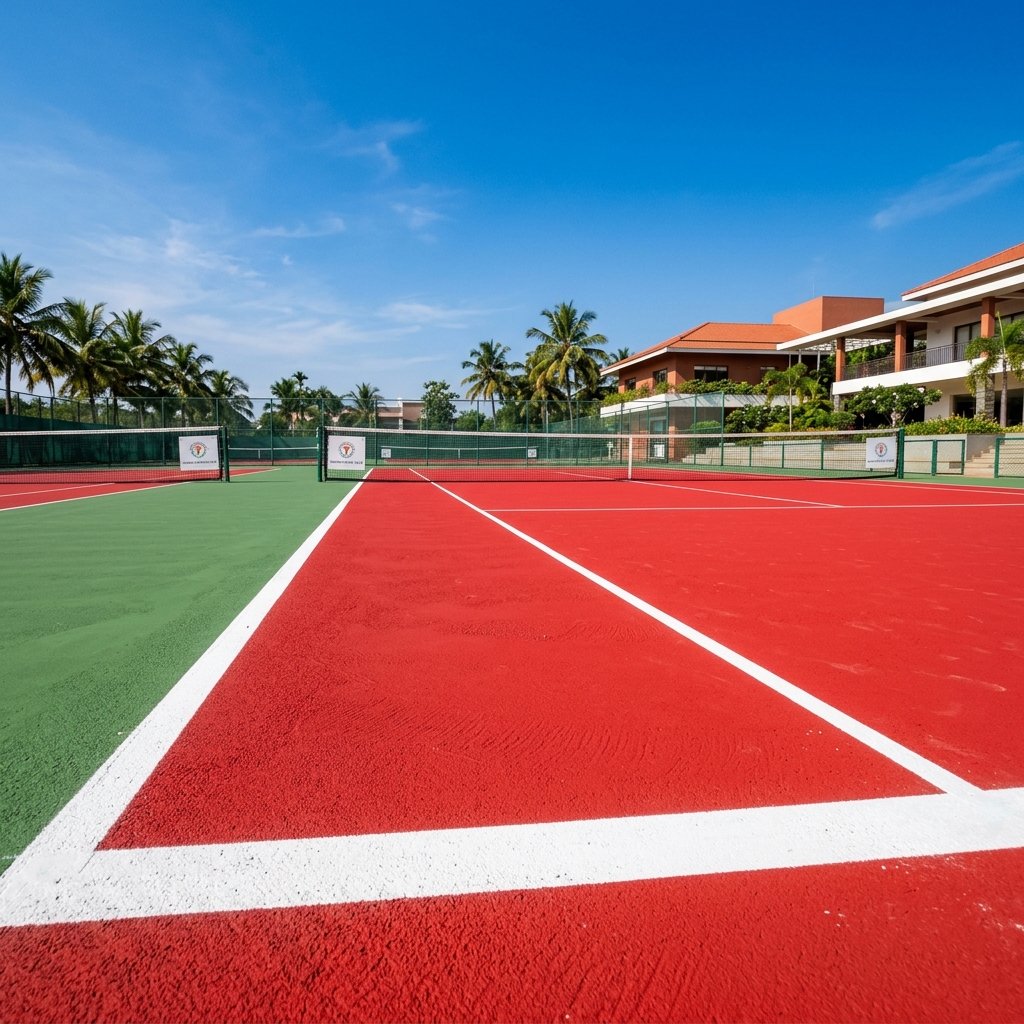
5-Layer vs 8-Layer Acrylic Court Systems: What Every School and Club Buyer Must Know
When schools, sports clubs, and badminton academies decide to build or upgrade their outdoor hard courts, the most critical decision involves the surface specification. Choosing the wrong surface leads to early structural failure, player injuries, and wasted budgets. The industry standard for outdoor tennis and multi-sport hard courts is the water-based acrylic polymer coating system. However, buyers are often presented with quotes for varying thicknesses, primarily the 5-layer non-cushion and the 8-layer premium cushion systems.
This guide breaks down exact acrylic sports court specifications, comparing the 5-layer and 8-layer systems layer-by-layer, to help institutional buyers make the right procurement decision based on player safety, ITF court pace classifications, and long-term durability.
Table of Contents
- What is an Acrylic Sports Court System?
- The 5-Layer Acrylic Court System (Non-Cushion)
- The 8-Layer Acrylic Court System (Premium Cushion)
- Cushion vs. Non-Cushion: The Player Safety Impact
- ITF Court Pace Classification Explained
- The Critical Importance of the Concrete Sub-Base
- Avoiding the Middleman Cost Inflation Trap
- Frequently Asked Questions
What is an Acrylic Sports Court System?
An acrylic sports court system is a multi-layered, water-based polymer emulsion applied over asphalt or concrete. It includes concrete primers, resurfacers, optional rubberised cushion coats, and textured colour coats containing silica sand, designed to provide consistent ball bounce, slip resistance, and weather protection.
Understanding the Chemistry and Application
Acrylic court systems are engineered surface coatings. Unlike modular surfaces such as PP interlocking sports tiles or indoor PVC vinyl sports flooring, acrylics are wet-poured and squeegee-applied directly onto a prepared structural sub-base. The system relies entirely on the structural integrity of the asphalt or M20 grade concrete beneath it. If the sub-base cracks, the acrylic layer will mirror that crack.
The primary function of the acrylic system is not structural support; it is to provide a specific playing characteristic. By adding 70-140 mesh premium silica sand into the colour wear coats, the system dictates the surface friction. This friction directly controls how the tennis ball grips the surface (dictating court speed) and how the player’s shoe interacts with the floor (dictating slip resistance).
UWIN Floortech applies these systems at temperatures between 10°C to 35°C, ensuring proper curing of the water-based polymers for maximum durability against Indian summer UV exposure.
The 5-Layer Acrylic Court System (Non-Cushion)
A 5-layer acrylic court is a non-cushioned hard court surface comprising one primer coat, one acrylic resurfacer coat, two textured colour wear coats, and line marking. It delivers a fast to medium-fast playing pace and is the standard for school basketball and recreational tennis.
Layer-by-Layer Construction
The 5-layer system is the workhorse of outdoor institutional sports flooring. It provides an excellent, durable, and brightly coloured playing surface without the added expense of rubberised shock absorption.
- Concrete Primer (1 Coat): A penetrating liquid that seals the concrete pores and creates a chemical bond between the bare concrete slab and the subsequent acrylic layers.
- Acrylic Resurfacer (1 Coat): A heavy-bodied acrylic emulsion mixed with silica sand. This layer fills minor voids, hides trowel marks in the concrete, and provides a uniform texture for the colour coats to adhere to.
- Texture Colour Coat (1 Coat): Highly pigmented acrylic coating mixed with specific mesh silica sand to provide the primary slip resistance and playing pace.
- Finish Colour Coat (1 Coat): A final pigmented layer that seals the texture, provides rich UV-stable colour, and ensures a uniform aesthetic finish.
- Court Line Marking (1 Coat): Heavy-duty, non-glare acrylic line paint applied precisely to ITF or FIBA dimensional standards.
Ideal Applications
The 5-layer non-cushion system is the most specified surface for school multi-sport courts, university outdoor basketball courts, and basic residential society recreational areas. Because it lacks a cushion layer, it is firmer underfoot, resulting in a faster ball bounce. It is highly durable and requires minimal maintenance beyond keeping the surface free of debris and standing water.
The 8-Layer Acrylic Court System (Premium Cushion)
An 8-layer acrylic court is a premium cushioned surface containing three distinct rubberised shock-absorbing layers between the resurfacer and the colour coats. It provides a slow to medium-slow pace, significantly reduces player joint fatigue, and is required for professional ITF tournament tennis clubs.
Layer-by-Layer Construction
The 8-layer premium cushion system represents the pinnacle of acrylic sports court specifications. By integrating distinct layers of rubber granules suspended in acrylic binders, this system transforms a rigid concrete slab into a forgiving, player-friendly sports surface.
- Concrete Primer (1 Coat): Seals the concrete and prepares the bonding surface.
- Acrylic Resurfacer (1 Coat): Levels the sub-base and provides the foundation.
- Heavy Cushion Coat (2 Coats): These layers consist of large-particle rubber granules mixed with acrylic binders. They provide the primary vertical shock absorption, compressing slightly under player impact to reduce force transfer to the knees and ankles.
- Fine Cushion Coat (1 Coat): A layer of smaller rubber granules that fills the voids left by the heavy cushion, smoothing the surface and preparing it for colour application while adding secondary elasticity.
- Texture Colour Coat (1 Coat): Pigmented acrylic with silica sand for grip and pace.
- Finish Colour Coat (1 Coat): Final UV-stable colour seal.
- Court Line Marking (1 Coat): Precision line painting.
(Note: The system is named “8-layer” based on the total applied coats, though the functional stages combine to create the final cushioned matrix.)
Ideal Applications
This system is mandated for serious tennis training academies, premium sports clubs, and tournament venues. The added rubber layers slow down the pace of the tennis ball, allowing for longer rallies and more strategic play, which is highly preferred by professional coaches. Most importantly, it allows athletes to train for hours daily without suffering from the shin splints and joint pain associated with non-cushioned concrete.
Cushion vs. Non-Cushion: The Player Safety Impact
Schools should choose cushioned acrylic courts if the budget allows, as the rubberised layers reduce knee and ankle impact by up to 20%, preventing chronic joint injuries. However, for multi-sport heavy foot traffic, non-cushion 5-layer systems offer higher resistance to scuffing and physical damage.
When comparing acrylic sports court specifications, player safety must be evaluated against facility usage patterns.
A tennis academy where athletes train for four hours a day must invest in the 8-layer cushion system. The repeated micro-traumas of running and stopping abruptly on rigid concrete lead to career-threatening joint injuries. The rubber matrix in the 8-layer system compresses under the athlete’s weight, absorbing the kinetic energy that would otherwise travel up the leg.
Conversely, a school playground that hosts basketball, morning assemblies, and general student foot traffic is often better served by the 5-layer non-cushion system. While it lacks shock absorption, it is significantly more resistant to damage from non-athletic shoes, dragged equipment, or heavy point loads. For ultimate player safety in a school environment where heavy multi-use is expected, UWIN Floortech often recommends entirely different surfaces, such as EPDM rubberised tracks for play areas or PP interlocking sports tiles for outdoor courts, which offer built-in structural shock absorption without the wear-and-tear vulnerability of acrylic cushion coats.
ITF Court Pace Classification Explained
ITF court pace classification is a rating system by the International Tennis Federation that measures surface friction and coefficient of restitution. It categorises tennis courts from Category 1 (Slow) to Category 5 (Fast), determined by the silica sand ratio within the acrylic colour coats.
Understanding court speed is essential for tennis academies. The pace of an acrylic court is not determined by the paint, but by the volume and mesh size of the silica sand mixed into the wear layers.
- Slow (Category 1) / Medium-Slow (Category 2): Typical of 8-layer cushion courts. More sand is added, creating higher friction. The tennis ball grips the surface and bounces higher and slower. Ideal for clay-court style baseline players and training facilities.
- Medium (Category 3): The standard balanced pace for general club play.
- Medium-Fast (Category 4) / Fast (Category 5): Typical of 5-layer non-cushion courts. Less sand means lower friction. The ball skids off the surface, keeping low and moving quickly. Preferred for serve-and-volley play styles.
UWIN Floortech formulates the silica sand ratios strictly according to the client’s requested ITF pace classification, ensuring the installed surface behaves exactly as specified for tournament preparation.
The Critical Importance of the Concrete Sub-Base
No, acrylic coating cannot fix a structurally damaged concrete court. Acrylic is a surface finish, not a structural material. Any existing cracks in the sub-base will reflect through the new acrylic layers within months. Damaged sub-bases require structural repair or a floating surface like PP tiles.
The most common mistake institutional buyers make is assuming an acrylic system will rescue a failing concrete slab.
For either a 5-layer or 8-layer system to succeed, the concrete must be of M20 grade minimum, properly cured for 28 days, equipped with a vapor barrier to prevent rising moisture, and sloped at 1% for surface drainage. Furthermore, the concrete must feature proper expansion joints to accommodate thermal movement.
If your school or club has a heavily cracked existing court, applying an acrylic resurfacer is a temporary cosmetic fix that will fail. In these scenarios, UWIN Floortech advises two options: completely demolish and rebuild the concrete sub-base, or install UV-stabilised PP interlocking sports tiles over the existing slab, which “float” above the cracks and ignore sub-base imperfections.
Avoiding the Middleman Cost Inflation Trap
The Indian sports infrastructure market is heavily fragmented. When a residential developer or school requests quotes for acrylic sports court specifications, they are almost exclusively dealing with trading middlemen via platforms like IndiaMART.
These middlemen add 25% to 40% margins on the chemical materials and outsource the installation to daily-wage painters who do not understand the technical requirements of silica sand suspension, temperature-controlled curing, or ITF pace standards. The result is peeling surfaces, inconsistent ball bounce, and zero accountability.
UWIN Floortech operates on a strict manufacturer-direct model. We supply certified water-based acrylic polymers and execute the turnkey installation using our own trained crews. For schools and clubs, this means you pay only for the materials and the labour - the trading margin is completely eliminated, and accountability rests with a single, highly technical provider.
Frequently Asked Questions
What is the difference between 5-layer and 8-layer acrylic tennis courts?
The primary difference is shock absorption. A 5-layer court is a non-cushioned hard surface consisting of primers, resurfacers, and colour coats. An 8-layer court includes additional heavy and fine rubberised cushion layers beneath the colour coats, which significantly reduce joint impact and slow the pace of the ball.
How much does it cost to build an ITF certified tennis court in India?
The cost varies based on the system. A 5-layer non-cushion acrylic system is the most cost-effective, while an 8-layer premium cushion system requires a higher investment due to the added rubber polymers. By working directly with a manufacturer like UWIN Floortech, buyers can eliminate the standard 30% trader markup, receiving exact pricing based on square footage and sub-base condition.
How often does an acrylic tennis court need to be resurfaced?
In Indian weather conditions, a properly installed acrylic tennis court typically requires resurfacing every 4 to 6 years. Resurfacing involves cleaning the court, repairing minor wear, and applying a new texture and finish colour coat to restore the grip, appearance, and ITF pace classification.